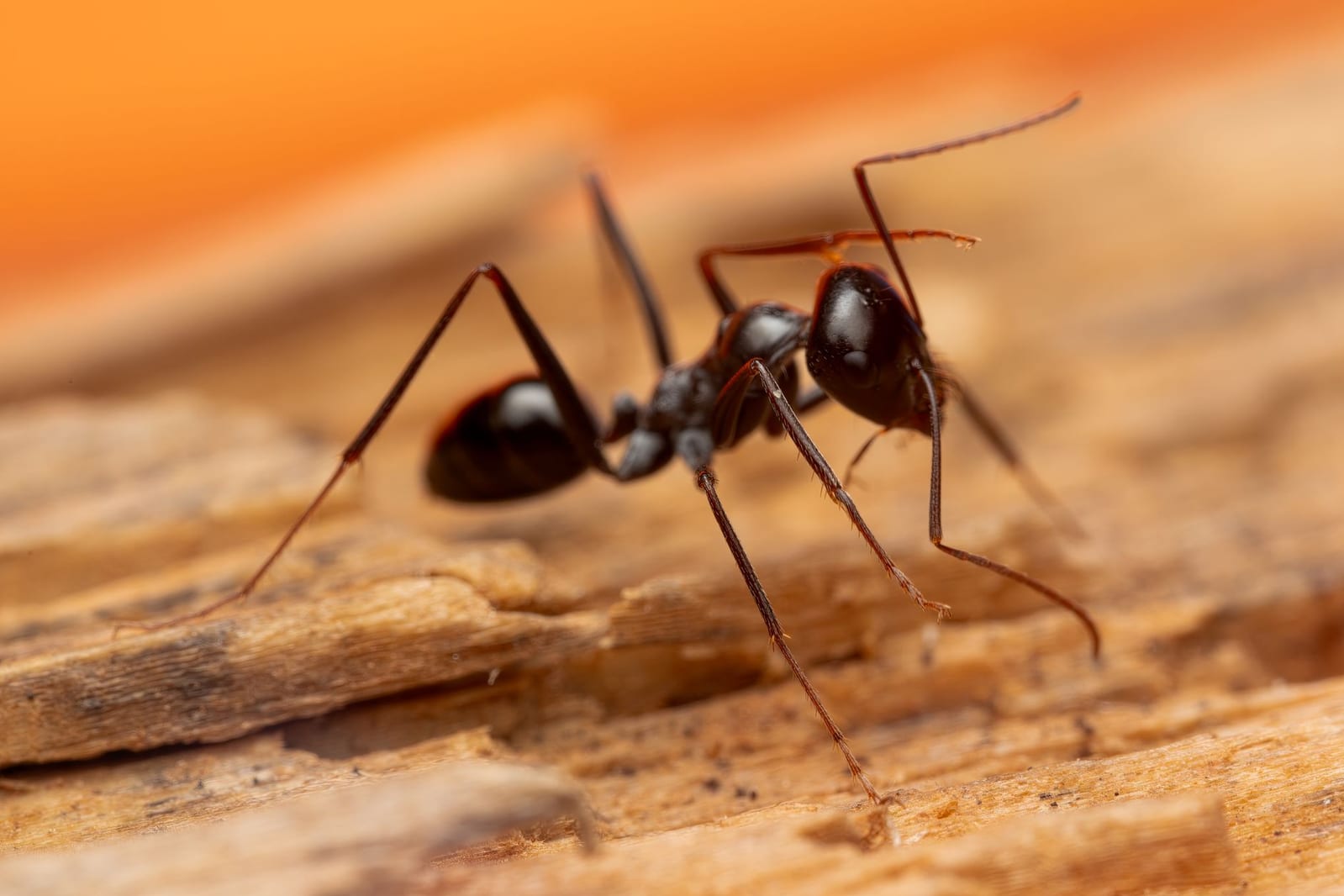
Harlem's green edges — Marcus Garvey Park, St. Nicholas Park and Morningside Park — drive the warm-season ant pressure residents deal with from spring through autumn. Ants foraging indoors are especially common in ground-floor, garden and brownstone-rear apartments that back directly onto these parks, where an outdoor colony has the shortest path inside.
Because the pressure originates outdoors, near a park boundary, treating only the indoor trail rarely holds for long in these units — we look for the entry point where the colony is actually crossing from the park-adjacent yard or garden into the building, not just where ants are visible on the counter.
Pre-war buildings and brownstones add their own factor: deep baseboard gaps and shared wall voids give foraging ants an easy route from an entry point into multiple rooms, which is why treatment here focuses on the entry path as much as the visible trail.
Are those large black ants in my NYC apartment carpenter ants — and are they dangerous?
University of Minnesota Extension explains that carpenter ants do not eat wood — they remove it to create galleries and tunnels for nesting, pushing the chewed-out sawdust outside. Their parent nests are found in moist or decayed wood from water leaks, condensation or poor air circulation, so an indoor carpenter-ant problem usually signals a hidden moisture issue that needs fixing too. (University of Minnesota Extension — Carpenter Ants)
University of Minnesota Extension describes how carpenter ant colonies operate as a parent nest plus one or more satellite nests: the parent nest needs moist wood, while satellite nests can hold workers, older larvae and pupae in drier wood closer to a food source indoors. This is why treating only the visible indoor foragers fails — the parent colony survives and re-seeds the satellites unless it is located and treated. (University of Minnesota Extension — Carpenter Ants)
University of California IPM explains why baiting beats spraying for ants: foraging workers carry small portions of bait back to the nest, where it is passed mouth-to-mouth to other workers, larvae and queens, killing the whole colony. Spraying around the foundation only kills the foragers you see, leaving the colony and its queens intact — so it will not provide permanent control. (UC Statewide IPM Program — Ants)
Penn State Extension notes that the swarming winged reproductives of carpenter ants are commonly mistaken for termite swarmers, but the two are easy to separate: ants have a constricted, pinched waist, elbowed (bent) antennae and front wings longer than the hind wings, whereas termites have a broad waist, straight beaded antennae and four wings of roughly equal length. (Penn State Extension — Carpenter Ants)
Utah State University Extension notes that odorous house ants — a common NYC look-alike for budding indoor colonies — get their name from the rotten, coconut-like smell they give off when crushed, a quick field test that separates them from pavement ants. About 3 mm long and brown-to-black, they readily nest indoors and reproduce by budding. (Utah State University Extension — Odorous House Ant)
Carpenter ants vs. termites — the two-minute identification check
| Carpenter ant | Eastern subterranean termite | |
|---|---|---|
| Waist | Pinched (petiole between thorax and abdomen visible) | Broad and uniform — no pinch |
| Antennae | Elbowed (bent at a clear angle) | Straight, beaded |
| Swarmer wings | Forewings noticeably larger than hindwings | All four wings roughly equal length |
| Frass / debris | Coarse, fibrous — looks like shredded wood mixed with insect parts | Fine soil/mud packed into galleries and mud tubes |
| Wood damage | Smooth galleries along the grain; clean inside (does not eat wood) | Galleries packed with soil and mud; never clean (eats wood) |
| Moisture requirement | Parent nest in already-softened, moist or decayed wood | Needs soil contact and high moisture; builds mud tubes |
How much does carpenter ant & ant control cost in NYC?
$60–$500
National average: $150–$250 per visit (Angi). Typical single treatment: $80–$500 (small infestation). Bob Vila national range: $60–$215. Follow-up/retreatment visits: $40–$120.
US national figure — NYC typically runs higher.
Market range — not our quote
This is a market range synthesised from published cost guides — not a quote from this provider. The actual price depends on an in-person or photo-based inspection.
US national — NYC typically higher; no NYC-specific ant cost guide located, unlike bed bugs/rats/roaches.
What drives the price
- Infestation location (attic/basement/exterior walls cost more than kitchen/living space due to access difficulty)
- Severity
- Treatment method
- One-off vs follow-up retreatment
Signs you have a ant control problem
- Ants foraging indoors, especially in ground-floor, garden, or brownstone-rear units
- Trails appearing seasonally from spring through autumn, tied to warmer weather
- Activity concentrated in units closest to Marcus Garvey Park, St. Nicholas Park, or Morningside Park
- Ants using deep baseboard gaps or shared wall voids to reach multiple rooms
Why Harlem sees this
Harlem's green edges — Marcus Garvey Park, St. Nicholas Park and Morningside Park — drive warm-season ant pressure from spring through autumn, most common in ground-floor, garden and brownstone-rear apartments backing onto the parks.
Harlem's pre-war buildings, brownstones and walk-ups have deep baseboard gaps and shared wall voids that let foraging ants spread between rooms once they're inside.